Faeto Ham
Reading time:
In the Alta Valle del Celone, where the southern Monti Dauni still keep an intact rural identity, Faeto ham tells of centuries of farming know-how. It is simple in its…
Faeto Ham: a flavour from far away
In the Alta Valle del Celone, where the southern Monti Dauni still keep an intact rural identity, Faeto ham tells of centuries of farming know-how. It is simple in its ingredients, pork, salt and a few spices, but complex in character: brick-red when sliced, with pinkish fat framing a slice of strong, lingering aroma. It is a product born here and still made here, and you can recognise it at a glance by its high trim which sets it apart among the artisan cured hams of Puglia
.
A village on the border between two worlds
Faeto is one of the highest municipalities in Puglia, perched at over 800 metres above sea level, with a feature rare in Italy: together with Celle di San Vito, it is one of only two municipalities in southern Italy where the Franco-Provençal language survives, known locally as “faetano”. This geographical and cultural isolation has preserved over the centuries not only a language but a way of life, a cuisine and a subsistence economy based on pig rearing. In this context the ham is not simply a typical product: it is part of the village’s identity.
The raw material: the pig of the Monti Dauni
Behind Faeto ham lies an old livestock tradition that is increasingly valued today. The pigs are reared in the countryside of Faeto, mainly in the Piano Maggese/Scavo area, in semi-wild conditions. For part of the year they feed freely on roots and berries, then their diet is supplemented with maize in winter and meal in summer.
In the past, pig farming in the Monti Dauni was characterised by native breeds linked to the traditional Nero Pugliese (Apulian black pig), also known as Nero dei Monti Dauni meridionali or Nero di Capitanata. In other parts of Puglia related breeds were found, remembered by local names such as Murgese nero and Nero di Gargano, an expression of the region’s historic livestock biodiversity. Hardy breeds, adapted to the land, with darker and tastier meat than industrial hybrids. This link with local raw materials is one of the strongest arguments for those who see the Capitanata black pig and semi-wild rearing as hallmarks of authenticity in the food of Puglia’s inland areas.
The process: four stages, no shortcuts
The making of Faeto ham has four distinct stages, each essential to the final result:
1. Dry salting: lasts about a month. The legs are treated with salt and spices
in proportions handed down orally from generation to generation.
2. Washing and drying: the legs are cleaned and left to dry, a key step for the correct formation of the crust.
3. Larding: the whole trimmed surface is coated with pre-warmed pork fat, applied strictly by hand. This is the most characteristic feature of the product: the high trim, covering almost the entire inner face of the ham, followed by careful coating that protects and firms the meat.
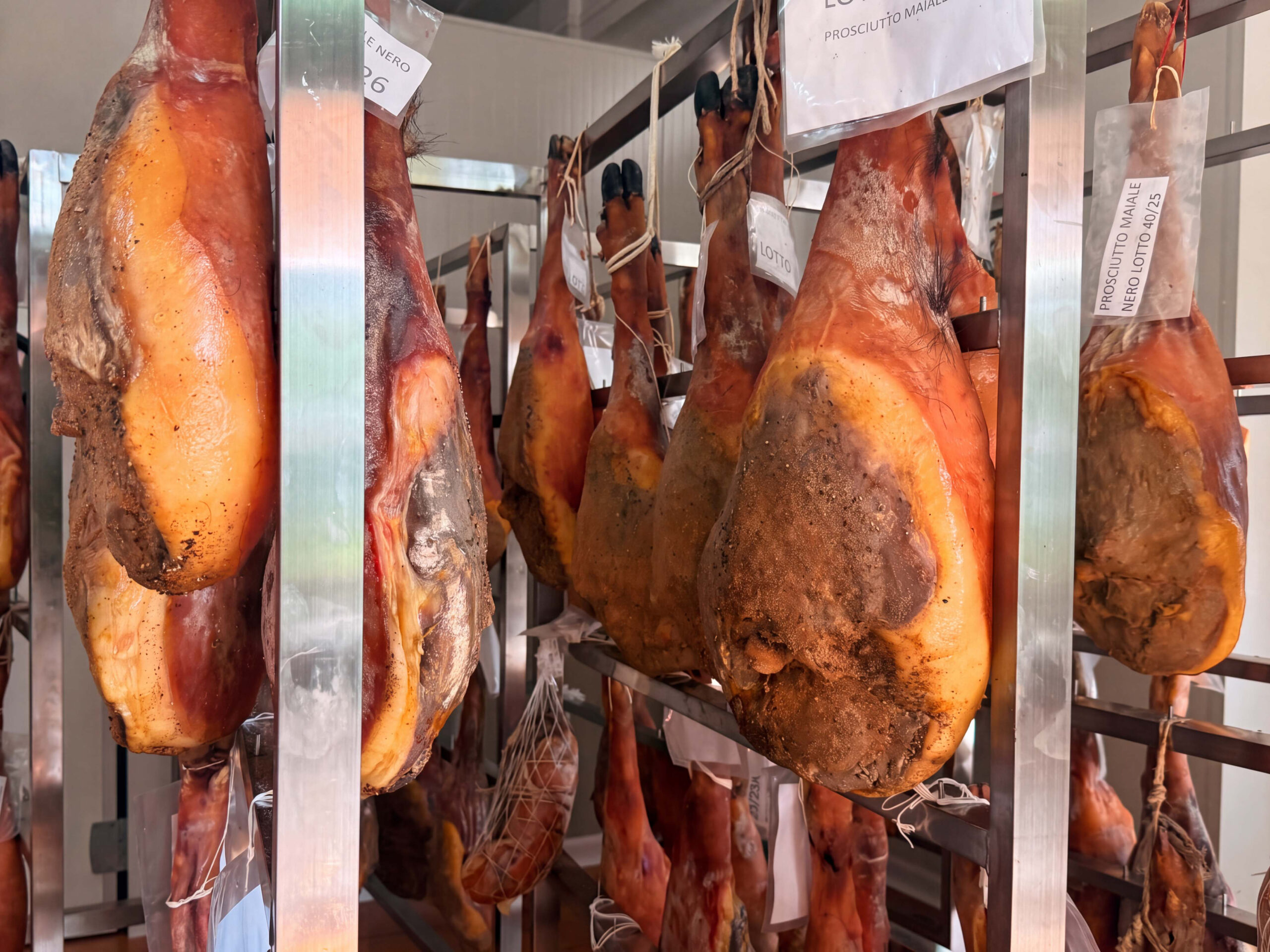
4. Ageing: no less than 12 months, at least the last two in rooms without forced ventilation, at an altitude above 700 m above sea level. It is the air of Faeto, cool, clean, with the typical breezes of the Monti Dauni, that completes the work.
The finished product weighs between 12 and 13 kilograms. It can be sold whole, boned, in portions, vacuum-packed or in a protective atmosphere.
Its inclusion in the national list of Traditional Agri-food Products (PAT) officially recognises the link between this ham and the territory that produces it.
Presutt de Fait: when food speaks Franco-Provençal
In the local language the ham is called presutt de Fait, and that word, Fait, is not Apulian. It is Franco-Provençal, like the community that makes it. This apparently minor detail says everything about the relationship between food and cultural identity in Faeto.
The Faeto Ham Festival: every first Sunday of August
If you want to discover Faeto ham in its authentic setting, there is an event worth the trip: the Faeto Ham Festival, held every year on the first Sunday of August. As well as being an excellent opportunity to taste the product, it is when the village opens up to visitors with its whole repertoire of flavours, sounds and traditions. A perfect occasion for anyone putting together a food itinerary in the Monti Dauni over a weekend, combining villages, landscape and table.
If you are wondering what to eat in Faeto during a visit, its ham is a good starting point, but not the only one. The village’s pork-curing tradition includes other pork products, each with its own history and season.
Where to buy Faeto ham
For those who want to take home a piece of this tradition, the most authentic answer is simple: come to Faeto. Local producers work by hand, in limited quantities and with a care that large-scale retail cannot replicate. Asking locally, from the producers, the village shops or at the festival, is still the most direct way to find out where to buy Faeto ham and take home a product that still has the flavour of the hands that made it.
Discover more of the heritage of Faeto and the Alta Valle del Celone
Faeto ham is one of the gateways to a territory with much more to tell. The food and wine of Puglia’s inland areas is only one chapter of this story: there are the landscapes of the southern Monti Dauni, the architecture of the historic village, the Franco-Provençal language, folk traditions and the nature trails crossing the Alta Valle del Celone.
Discover more places in Faeto and the Alta Valle del Celone: the history, culture, traditions and flavours of a corner of Puglia that reveals itself slowly to those who want to look for it.
AT A GLANCE
Where
Faeto
Type
Suitable for
Everyone
Interests
SHARE


PODCAST
L’Alta Valle del Celone
Ten episodes exploring Celle di San Vito, Faeto and Castelluccio Valmaggiore through the voices of those who live in these places every day.
An audio journey through stories, memories, traditions, landscapes and flavours, told by the people of the three towns. The podcast guides visitors in discovering the authentic soul of the Alta Valle del Celone: a land of forests, villages and vibrant communities, where every voice preserves a piece of its identity.
Recommended experiences
Alta Valle del Celone: a training day on communicating the destination
A meeting in Castelluccio Valmaggiore on the future of tourism …
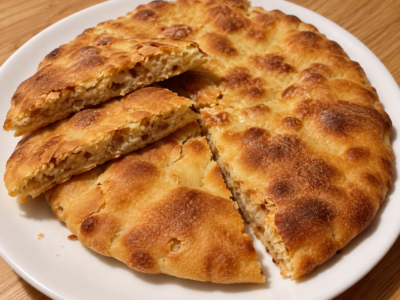
Pizza with pork crackling
La pizze dò le cíccule: the crackling pizza of the …
Keep exploring
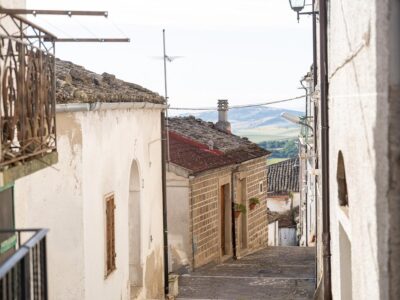
The village lanes
The lanes of Castelluccio Valmaggiore: where stone tells stories …
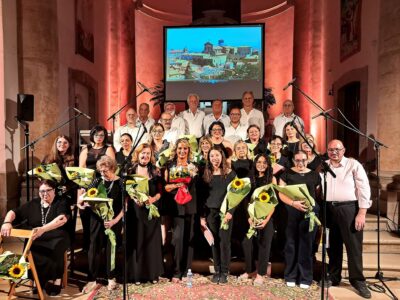
The Faeto Choir
Nuova Provenza Choir, Faeto: the voices that keep a language …

Monte Cornacchia
Monte Cornacchia: the highest peak in Puglia, in the heart of …