In the Footsteps of Pilgrims: The Via Francigena in Castelluccio Valmaggiore
Tempo di lettura:
An Ancient Route in the Heart of Inland Puglia The Via Francigena is more than just a geographical route: it is one of the great roads of European history. Originating…
An Ancient Route in the Heart of Inland Puglia
The Via Francigena is more than just a geographical route: it is one of the great roads of European history. Originating as a pilgrimage route between Canterbury and Rome, and later extended toward Jerusalem, it crossed the continent for centuries, carrying pilgrims, merchants, and crusaders from one end of the known world to the other. In Puglia, this route entered from the north, descending through the Daunian Sub-Apennines, and its trace can still be read in the landscape and in the memory of the villages it passed through. Among them, Castelluccio Valmaggiore occupies a distinct position: a stopping place, a gateway, a place where the route and local history became intertwined forever.
To speak of the Via Francigena in Castelluccio Valmaggiore is to speak of a territory that mass tourism has not yet worn away, where every path carries layers of meaning dating back to the Middle Ages.
The Via Francigena of the South: History and Route Through the Monti Dauni
The Origins of the Route and the Role of Puglia
The Via Francigena of the South is the southern branch of the great European pilgrimage route. While the main route led to Rome, the Puglian section continued toward the Adriatic ports of Brindisi, Otranto, and Bari, from where pilgrims embarked for the Holy Land. This made Puglia a strategic corridor, crossed by thousands of travelers between the 11th and 14th centuries.
The route entered the region through the Monti Dauni, the most inland and mountainous area of Capitanata, following ancient roads, some of which coincide with the tratturi, the transhumance routes that crossed the territory from north to south. Its connection with the Via Appia Traiana and the tratturo network is one of the most fascinating aspects of this section: the history of Puglia’s transportation routes overlaps almost inseparably here, and Castelluccio Valmaggiore stands at this crossroads.
The Section Between Faeto, Celle di San Vito, and the San Vito Pass
Among the most significant stages of the Via Francigena of the South in the Province of Foggia, the section through the Alta Valle del Celone passes near villages such as Faeto and Celle di San Vito, Puglia’s two Franco-Provençal communities, via the San Vito Pass, a landscape and historical crossroads that still offers striking panoramic views. For those planning a hike along the Via Francigena in the Monti Dauni, this section is one of the most intact from both an environmental and cultural perspective.
Trekking through the Alta Valle del Celone along the Via Francigena does not require exceptional athletic preparation, but rather a genuine willingness: to walk slowly, to observe the landscape with curiosity, and to embrace slowness as a means of understanding.
Slow Tourism in Inland Areas: A Different Way to Travel
Slow tourism in the inland areas of Puglia has found one of its main expressions in historic walking routes. In this sense, the Via Francigena is not merely a tourism product: it is a cultural practice that restores to the traveler a dimension of the landscape that would otherwise remain invisible.
Walking these trails means encountering vernacular rural architecture, abandoned farmhouses, roadside shrines along the tratturi, and woodlands where silence is still a tangible presence. It also means discovering the gastronomy of the Monti Dauni: the traditional products of this land, from durum wheat to sheep’s milk cheeses, from seasonal vegetables to the wines of the Daunian Sub-Apennines, which along the route become a defining element of local identity rather than a secondary attraction.
Travelers walking the Via Francigena through Castelluccio Valmaggiore will not find extensive tourist infrastructure, but they will find something far more difficult to replicate: an unspoiled setting where the tangible and intangible heritage of a medieval village in Puglia is still alive in the everyday fabric of the community.
Discover the Entire Territory
The Via Francigena is one of the threads woven into the identity of Castelluccio Valmaggiore, but it is not the only one. This village in the Alta Valle del Celone preserves a layered history, enduring local traditions, and a rural culture that has left its mark everywhere: in its churches, festivals, cuisine, and dialect.
Explore the other places in Castelluccio Valmaggiore and the Alta Valle del Celone: discover the local traditions, nature itineraries, the history of the village, local events, and the authentic flavors of this inland corner of Puglia.
AT GLANCE
Where
Castelluccio Valmaggiore
Type
Suitable for
All
Interests
SHARE


PODCAST
L’Alta Valle del Celone
Ten episodes exploring Celle di San Vito, Faeto and Castelluccio Valmaggiore through the voices of those who live in these places every day.
An audio journey through stories, memories, traditions, landscapes and flavours, told by the people of the three towns. The podcast guides visitors in discovering the authentic soul of the Alta Valle del Celone: a land of forests, villages and vibrant communities, where every voice preserves a piece of its identity.
Recommended experiences
The Highest Municipality in Puglia
The geography of the inland Foggia area holds remarkable …

Fresh Pasta Festival in Castelluccio Valmaggiore
Summer in the small villages of the Puglian (Apulian) Apennines …
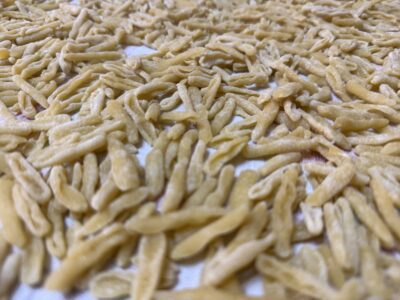
Fresh Pasta in Celle di San Vito
There is an inseparable bond between the table of a small …
Keep exploring
The Highest Municipality in Puglia
The geography of the inland Foggia area holds remarkable …
Fresh Pasta Festival in Castelluccio Valmaggiore
Summer in the small villages of the Puglian (Apulian) Apennines …
Fresh Pasta in Celle di San Vito
There is an inseparable bond between the table of a small …

Ppìzze do le ccìcule: The Ciccioli Pizza of the Franco-Provençal Communities
There is a dough that carries the flavor of January. Of …