Porta del Pozzo and Porta del Piscero: The Stone Gateways That Tell the Story of Castelluccio Valmaggiore
Tempo di lettura:
Porta del Pozzo and Porta del Piscero are stone gateways that mark the boundary between the village and the outside world, between the present day and a history rooted in…
Porta del Pozzo and Porta del Piscero are stone gateways that mark the boundary between the village and the outside world, between the present day and a history rooted in the 11th century. Passing through them today means entering the historic center of Castelluccio Valmaggiore with the awareness that these stones have endured for nearly a thousand years.
A Village Designed Like a Fortress
Castelluccio Valmaggiore stands in the Alta Valle del Celone, in the heart of the Monti Dauni (Dauni Mountains), in that part of inland Apulia (Puglia) where every hill bears the weight of a quiet history. The village did not develop by chance: its urban layout follows the shape of an isosceles triangle, a precise defensive geometry designed to withstand attack.
At the two ends of the triangle’s base stood the two main gates: Porta del Pozzo and Porta del Piscero. At the opposite vertex, the most exposed point and the weakest side of the perimeter, the Castle was built to guard the only area made more vulnerable by the terrain. The gates, the castle, and the walls all followed a coherent military strategy, typical of medieval defensive architecture.
The Medieval Gates of Castelluccio Valmaggiore and Their Byzantine Origins
The village’s defensive walls are directly linked to the Byzantine presence in this part of the Daunian Sub-Apennines. They date back to the 11th century, during the time of the Catapan Basilio Boioannes, when the Byzantine Empire sought to strengthen its control over southern Italy through a network of fortified settlements.
The Byzantine walls of Castelluccio Valmaggiore were not merely a military defense: they also represented a statement of authority and territorial organization. The gates were their most representative elements, serving as the controlled access points through which everyone entered the village. Porta del Pozzo took its name from a nearby well, a vital water source for a community enclosed within the walls. Porta del Piscero, whose name most likely refers to fishing or to a particular feature of the landscape, completed the access system at the base of the triangle.
Ancient Arches Within the Fabric of the Village
The two gates formed part of an integrated defensive system that also included other arches and smaller passageways scattered throughout the village, such as those on Via Osteria and Via Gradelle. Walking through the narrow streets of the medieval village in the Alta Valle del Celone today means encountering these architectural traces almost without noticing them: an arch spanning a narrow street, a threshold worn smooth by time, a squared stone projecting from a tuff wall.
For those who live in Castelluccio, these elements are simply part of the everyday landscape. For visitors, however, they offer an authentic way to interpret the local history. The ancient arches and gateways of the villages of the Daunian Sub-Apennines are rarely documented with the same attention given to great urban monuments, making their discovery all the more meaningful.
What to See in Castelluccio Valmaggiore, Starting from the Gates
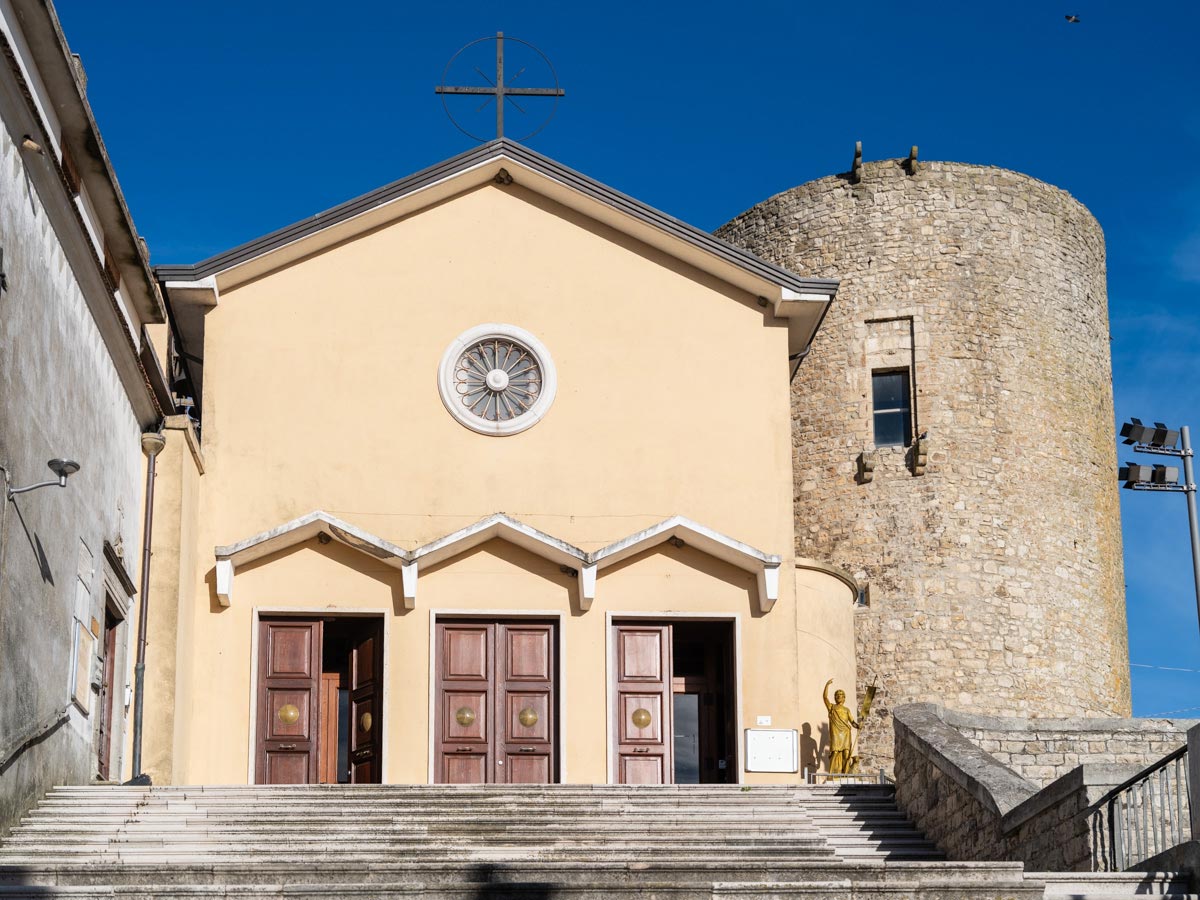
The two gates are the ideal starting point for exploring the historic center of Castelluccio Valmaggiore. From here, a route unfolds leading to the Cylindrical Tower, the Church of Santa Maria delle Grazie, and the Castle; the three landmarks that, together with the walls, define the village’s architectural identity.
Castelluccio forms part of the network of historic villages in the inland areas of Apulia, together with Celle di San Vito and Faeto, which in recent years have been rediscovered as destinations for slow tourism, appealing to those interested in the medieval history of the Celone Valley and its Byzantine origins. It is not a destination for mass tourism, but for travelers seeking an authentic experience and a genuine connection with the land.
Continue Discovering Castelluccio Valmaggiore
The medieval gates are only the beginning. Discover the other places to visit in Castelluccio Valmaggiore, its traditions, local stories, nature itineraries through the Monti Dauni (Dauni Mountains), and the food and wine heritage of the Alta Valle del Celone. The tangible and intangible heritage of this village is far richer than it first appears.
AT GLANCE
Where
Castelluccio Valmaggiore
Suitable for
All
SHARE


PODCAST
L’Alta Valle del Celone
Ten episodes exploring Celle di San Vito, Faeto and Castelluccio Valmaggiore through the voices of those who live in these places every day.
An audio journey through stories, memories, traditions, landscapes and flavours, told by the people of the three towns. The podcast guides visitors in discovering the authentic soul of the Alta Valle del Celone: a land of forests, villages and vibrant communities, where every voice preserves a piece of its identity.
Recommended experiences

The Highest Municipality in Puglia
The geography of the inland Foggia area holds remarkable …

Fresh Pasta Festival in Castelluccio Valmaggiore
Summer in the small villages of the Puglian (Apulian) Apennines …
Fresh Pasta in Celle di San Vito
There is an inseparable bond between the table of a small …
Keep exploring
The Highest Municipality in Puglia
The geography of the inland Foggia area holds remarkable …
Fresh Pasta Festival in Castelluccio Valmaggiore
Summer in the small villages of the Puglian (Apulian) Apennines …
Fresh Pasta in Celle di San Vito
There is an inseparable bond between the table of a small …

Ppìzze do le ccìcule: The Ciccioli Pizza of the Franco-Provençal Communities
There is a dough that carries the flavor of January. Of …