
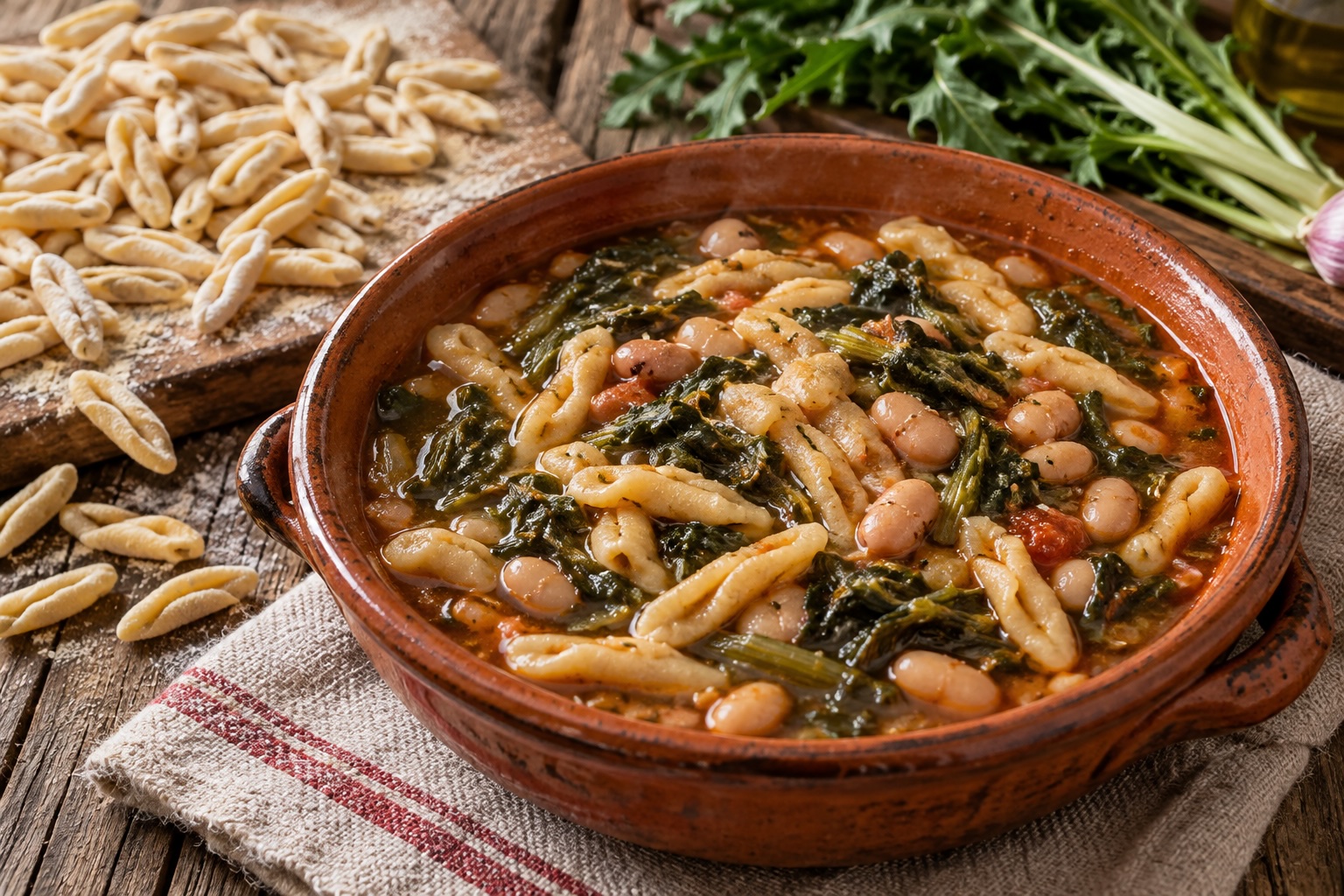
Cavatelli with beans, cicorioni with beans
Reading time:
In Faeto, cecatielli and beans: pasta that tells the story of a territory. In Faeto, cooking has never been simply about nourishment. It has been, and still is, a way…
In Faeto, cecatielli and beans: pasta that tells the story of a territory.
In Faeto, cooking has never been simply about nourishment. It has been, and still is, a way of living in the territory, handing down gestures and recognising oneself in a community. Cavatelli with beans from Faeto, known in dialect as cecatielli e fagioli, are one of those dishes that speak first of all of the land where they are born.
A mountain pasta in the Alta Valle del Celone
In the food of Puglia’s inland villages, cavatelli hold a special place. Here they are not just a pasta shape found all over Puglia: they are the pasta of the hill villages, where durum wheat met the pulses of the fields and the greens gathered along the paths. In the Alta Valle del Celone this tradition has found one of its most authentic and least altered expressions.
Cecatielli with beans from the Alta Valle del Celone are still made today as they were in peasant kitchens: few ingredients, long cooking, no shortcuts. The dough, made with durum wheat semolina, soft wheat flour and warm water, is worked by hand on the pastry board and dragged with one or two fingers to form the characteristic hollow. That gesture, repeated for centuries, is as much part of the dish as the ingredients.
The recipe between history and local identity
Cavatelli with beans: one dish, two souls
The version with beans is the heart of the traditional frugal cooking of northern Puglia. The beans, often borlotti or cannellini, are cooked slowly with fresh tomato, celery, carrot, garlic and extra virgin olive oil. Chilli pepper adds character without overpowering. The result is a dense, warming dish that fills you up and warms you at the same time.
There is also a variant in which Mentha pulegium, wild pennyroyal, is added while the beans cook, a practice common in the Apennine area bordering Samnium and Irpinia, which gives the dish an intense, wild aroma. Knowing this variant helps you understand that Faeto is not an isolated place: it is a crossroads of cultural exchanges built up over time.
Cicorioni with beans: the green version
The Faeto recipe also has another form. In the version with chicory or cicorioni (wild greens of the area), the tender leaves are cleaned, washed and sautéed with oil, onion and chilli, then combined with the beans for a complete one-dish meal. There is a red version, with tomato, and a white one. Both rightly belong among the traditional recipes of the Monti Dauni that this village has preserved without turning them into folklore.
Faeto: a medieval Franco-Provençal village with a cuisine all its own
Those wondering what to eat in Faeto come into contact
with a cuisine that never had to adapt to tourists’ tastes because, until not long ago, tourists hardly came. The local restaurants and farm stays that still serve cecatielli with beans or chicory bring to the table something hard to find elsewhere.
A dish to taste, a festival to enjoy
Autumn and winter are the seasons when these dishes are at their best, and it is no coincidence that they are also the seasons of the events that enliven the village. The Faeto Pork Festival and the festivals celebrating local specialities draw visitors every year from all over Puglia and beyond, turning food into a collective moment, a community rite.
If you are here in summer or spring, look for a farm stay that makes them anyway: you will find that cecatielli e fagioli have no wrong season when the ingredients are right.
Keep exploring Faeto and the Alta Valle del Celone
Faeto has a medieval history to read in its lanes, a language to listen to, and nature to explore on foot through woods and ridges. The Alta Valle del Celone offers a heritage of villages, knowledge and landscapes that deserves to be discovered with the time it requires.
Discover more places, traditions and intangible heritage of the Alta Valle del Celone.
AT A GLANCE
Where
Faeto
Type
Suitable for
Everyone
Interests
SHARE


PODCAST
L’Alta Valle del Celone
Ten episodes exploring Celle di San Vito, Faeto and Castelluccio Valmaggiore through the voices of those who live in these places every day.
An audio journey through stories, memories, traditions, landscapes and flavours, told by the people of the three towns. The podcast guides visitors in discovering the authentic soul of the Alta Valle del Celone: a land of forests, villages and vibrant communities, where every voice preserves a piece of its identity.
Recommended experiences
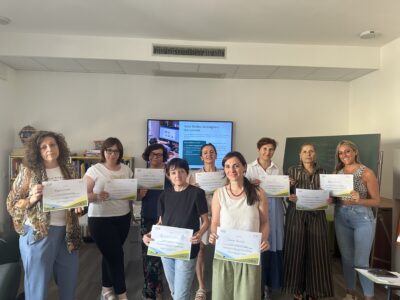
Alta Valle del Celone: a training day on communicating the destination
A meeting in Castelluccio Valmaggiore on the future of tourism …
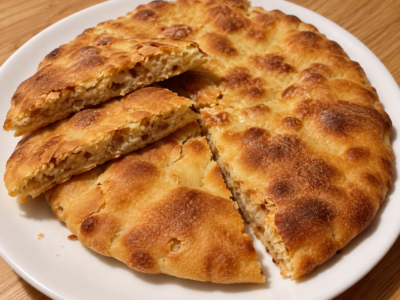
Pizza with pork crackling
La pizze dò le cíccule: the crackling pizza of the …
Keep exploring

Ponte del Freddo
Ponte del Freddo, Castelluccio Valmaggiore Stone architecture …
The Faeto Choir
Nuova Provenza Choir, Faeto: the voices that keep a language …
Rifugio Casonetto CAI
Rifugio Casonetto: the only CAI refuge in Puglia. At 700 metres …
Faeto lamb stew
Lu spezzatiélle: Faeto’s Easter Monday dish. There is one day of …