
Peccelatiélle of Faeto
Reading time:
In Faeto, once upon a time, even a tarallo could tell of a promise. Peccelatiélle, the traditional egg taralli of the Franco-Provençal village, accompanied some of the most important moments…
Peccelatiélle of Faeto: the egg taralli that tell of old wedding traditions
In Faeto, once upon a time, even a tarallo could tell of a promise. Peccelatiélle, the traditional egg taralli (ring-shaped biscuits) of the Franco-Provençal village, accompanied some of the most important moments of family life, from engagement to marriage. Made to be offered and shared, they were part of a language of gestures, customs and small gifts through which a community celebrated the birth of a new family. A food tradition that tells much more than a recipe: it tells how Faeto lived its celebrations, its family relationships and life’s turning points.
When food became a promise
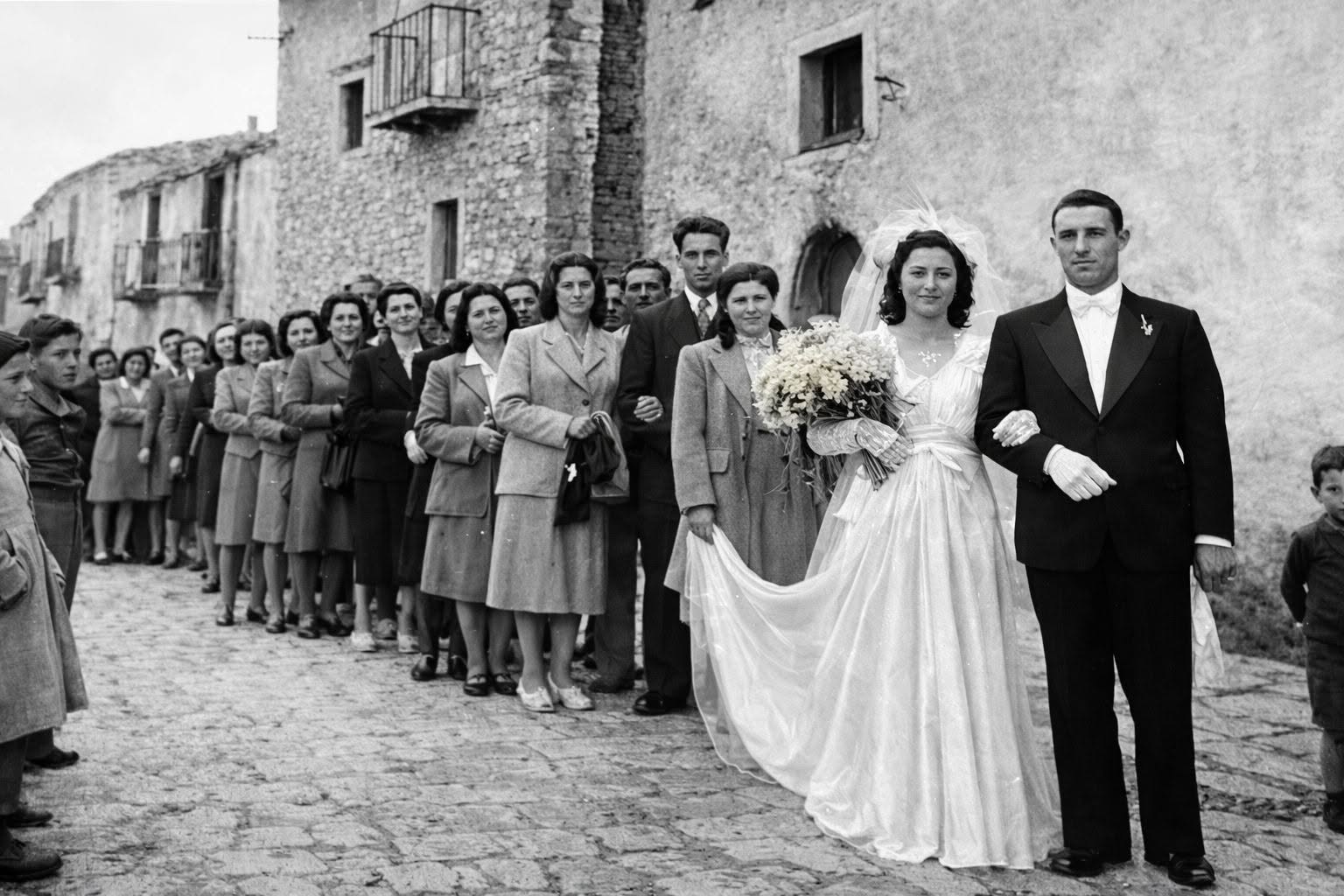
Among the specialities of Faeto’s traditional cooking, peccelatiélle have a special place. Their value lay not only in the ingredients or the making, but above all in the meaning they took on during wedding ceremonies. (Photo from the archive of Aldo Genovese)
At over 800 metres above sea level, in the heart of the Daunian Subapennines, Faeto holds a unique cultural history, deeply marked by the Franco-Provençal language. It shares this feature with neighbouring Celle di San Vito, a sign of the medieval origins of the two communities and of the survival of a linguistic and cultural heritage rare in southern Italy.
In this context, food traditions are also a form of collective memory. Some dishes were for every day, others appeared mainly on feast days, when food took on symbolic value and became an integral part of community rituals.
Peccelatiélle belonged to the second category. They were egg taralli that accompanied Faeto’s old wedding customs, appearing on the table at precise moments along the path that led a young couple to marriage.
Lo Peccelatiélle: the egg tarallo of Faeto’s tradition
Peccelatiélle were baked with eggs, unlike the common savoury taralli flavoured with fennel seeds. Local tradition keeps their name and records above all their use in ceremonies linked to marriage.
The use of eggs places this speciality within the large family of traditional baked goods of southern Italy, where simple ingredients could be turned into preparations reserved for important occasions.
In Faeto, however, what makes this speciality particularly interesting is the role it played in the social life of the village.
The tarallo became a gift, a sign of hospitality and participation, a food made to be shared with relatives and guests. It was not just something on the table but a recognisable element of the celebration, associated with the promise of marriage and the wedding festivities.
The available accounts allow us to reconstruct their meaning within old local customs, while a complete, documented recipe, with the proportions of the ingredients and the precise method, still requires further research in the village’s culinary memory.
The promise of marriage: the first meeting between families
To understand the meaning of peccelatiélle we need to go back to the Faeto of a few generations ago, when marriage was not only the union of two people but an event involving both families and often a large part of the community.
Courtship followed precise customs. Young people had few chances to meet: on the road to the fountain, during religious processions or on Sundays after Mass. Sometimes a glance and a few gestures were enough to show interest.
When the young man’s intentions became serious, a special figure came on the scene: the ambassador. It was he who went to the girl’s father to convey the proposal and sound out the family’s willingness.
If the answer was favourable, the young man came with his relatives. The engagement was usually celebrated on a Thursday or Sunday, with wine, taralli, and toasted chickpeas and maize.
During these meetings the timing and arrangements of the wedding were also discussed, a custom that turned the engagement into an agreement recognised by both families.
Peccelatiélle appeared at the promise of marriage before the parish priest. On returning from the ceremony, the engaged couple and their relatives gathered at the girl’s house, where wine, fennel taralli and the characteristic egg taralli were offered.
A festive moment in which food accompanied the meeting, sealed the agreement and helped make public a promise that would change the lives of the two young people.
Marriage in Faeto: a celebration involving the whole village
Old Faeto weddings were marked by gestures and customs that began long before the religious ceremony.
Weddings were usually held on a Sunday, often in the winter months, when work in the fields left farming families more free time.
One of the bride-to-be’s most demanding tasks was preparing her trousseau. Helped by the women of the family, she worked wool, made clothes and embroidered sheets, towels and tablecloths for the new home.
On the Thursday before the wedding a particularly significant rite took place: carrying the bed and trousseau. After being displayed for a few days, the trousseau was taken to the couple’s home in large baskets, showing the community the work done by the bride’s family.
The wedding day began with the dressing of the bride. Her clothes, often made by the village dressmakers, could be colourful and, in wealthier families, made of precious fabrics.
Relatives and friends accompanied the couple in procession to the church. After the ceremony the celebration continued with the banquet, usually held in private homes made available for the occasion.
The tables were laden with traditional dishes: broken ziti with ragù, stew, roasts, cheeses, hams and fruit. Hearty dishes expressing a food culture in which the abundance of great occasions was also a gesture of welcome towards the guests.
Peccelatiélle and savoiardi: the couple’s old wedding favour
One of the most interesting aspects of the peccelatiélle tradition is their use at the end of the wedding reception.
As the banquet drew to a close, amid celebrations and jokes, the couple gave the guests a gift of savoiardi (sponge fingers) and peccelatiélle.
It was an edible wedding favour, far from the decorative objects that usually accompany ceremonies today.
The gift had an immediate meaning: to thank those who had taken part in the celebration and let guests take home something of the day.
The egg taralli thus became a tangible memento of the wedding, a small piece of the celebration that entered the homes of relatives and friends.
In a society where moments of plenty were closely tied to great occasions, giving baked goods meant sharing a happy moment and showing gratitude.
It is precisely this detail that makes peccelatiélle more than just a culinary speciality: their story helps reconstruct social relations, family habits and the value attributed to the small gestures of community life.
The culinary memory of the Franco-Provençal villages
Faeto’s food traditions belong to a wider cultural heritage, that of the Alta Valle del Celone and its villages of Franco-Provençal origin.
Faeto and Celle di San Vito share a linguistic and cultural history that has crossed the centuries, keeping expressions, stories and customs handed down above all through family memory.
The closeness of the two communities invites us to look at possible connections between their food traditions, without automatically assuming that dishes and rituals documented in only one of the two villages are shared.
In the case of peccelatiélle, the available accounts attest to their role in Faeto’s old wedding ceremonies. Their story is therefore a significant piece of local memory, but also a way of understanding how much cooking can tell about a territory.
In rural communities, food accompanied the key stages of life: birth, religious feasts, engagements, weddings and family occasions.
Every preparation had a function beyond nourishment. Cooking also meant keeping a custom, recognising oneself in a community and passing on a way of life to the next generations.
Discovering Faeto through traditional flavours
Visitors to Faeto, among the woods and landscapes of the Daunian Subapennines, find a village where historical memory is expressed through language, architecture, folk festivals and food.
Alongside the best-known products of the local cuisine, such as Faeto ham and peasant dishes, there are specialities whose meaning emerges above all through people’s stories and old customs.
Peccelatiélle belong to this less visible side of the culinary heritage: that of recipes linked to family events, collective rituals and gestures of sharing.
Knowing their story means approaching a Faeto of weddings celebrated at home, trousseaus made by hand, processions through the village streets and small gifts handed out to guests.
A heritage of memory that deserves to be told and explored, because it holds aspects of daily life that rarely find a place in the great accounts of history.
And perhaps this is the special quality of peccelatiélle: they remind us that, in a small village of the Monti Dauni, even a simple tarallo could become the symbol of a promise, a celebration and a whole community.
Keep exploring Faeto and the Alta Valle del Celone
Behind every typical product there is a story, a landscape, a community. Discover more places, traditions, history and itineraries of Faeto and the Alta Valle del Celone: from rural architecture to religious feasts, from nature trails to the Franco-Provençal language that still echoes among these stone houses.
AT A GLANCE
Where
Faeto
Type
Suitable for
Everyone
Interests
SHARE


PODCAST
L’Alta Valle del Celone
Ten episodes exploring Celle di San Vito, Faeto and Castelluccio Valmaggiore through the voices of those who live in these places every day.
An audio journey through stories, memories, traditions, landscapes and flavours, told by the people of the three towns. The podcast guides visitors in discovering the authentic soul of the Alta Valle del Celone: a land of forests, villages and vibrant communities, where every voice preserves a piece of its identity.
Recommended experiences
Alta Valle del Celone: a training day on communicating the destination
A meeting in Castelluccio Valmaggiore on the future of tourism …
Pizza with pork crackling
La pizze dò le cíccule: the crackling pizza of the …
Keep exploring
Castle of Crepacore
Castrum Crepacordis: the medieval castle that watched over the …
Handmade Pasta Festival
Handmade Pasta Festival in Castelluccio Valmaggiore. Summer in …

Rifugio Casonetto CAI
Rifugio Casonetto: the only CAI refuge in Puglia. At 700 metres …
Lamb Castelluccio-style
The culture of a place is expressed through its ability to …