Saint Salvatore Church in Faeto: History, Art, and Identity at the Heart of the Village
Tempo di lettura:
In the centre of Faeto, the village’s Mother Church rises over the main square with its grey stone façade and a presence that cannot go unnoticed. It is the Parish…
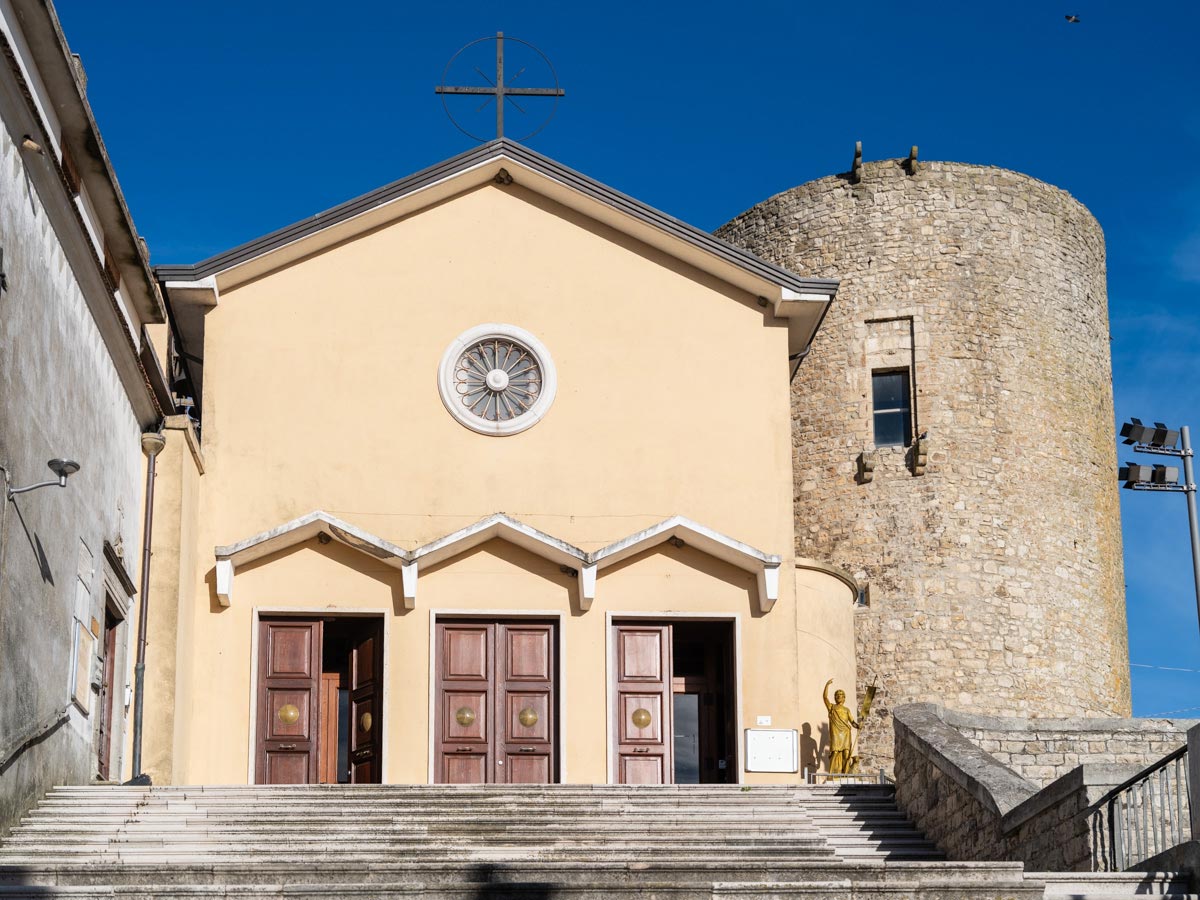
In the centre of Faeto, the village’s Mother Church rises over the main square with its grey stone façade and a presence that cannot go unnoticed. It is the Parish Church of the Most Holy Saviour, the spiritual and architectural landmark of one of the most distinctive municipalities in the inland areas of Puglia (Apulia). Those who come to Faeto to discover this Franco-Provençal village in the Monti Dauni find it hard to overlook: it stands there, solid and ancient, reminding every visitor that behind every stone lies a story worth discovering.
An Extraordinary Village, an Extraordinary Church
Faeto is unique among the medieval villages of the Monti Dauni. Its identity is built upon an exceptional cultural layering: a community of French origin that has preserved the Franco-Provençal language for centuries, a hilltop position in the Dauni Apennines, and an architectural heritage that tells centuries of religious and political history. In this context, the Church of the Most Holy Saviour is far more than a place of worship. It is the physical reflection of the historical tensions, political decisions, and popular devotion that have shaped the very identity of the village.
The Origins: Pope Pius V and the Response to Waldensian Protestantism
The history of the church begins in the second half of the 16th century, during a period of profound religious transformation throughout Europe. At that time, a small French Waldensian community had settled in Faeto, probably attracted by the Franco-Provençal language spoken in the village, a linguistic affinity that made this corner of Puglia feel far less foreign than geography might suggest.
The response of the Catholic Church was direct: Pope Pius V ordered the construction of this building as a concrete instrument of the Counter-Reformation, strengthening Catholicism in a territory where signs of religious division had begun to emerge. The church was therefore conceived not only as a place of prayer but also as a cultural and religious stronghold, with a symbolic significance that remains evident in its imposing architecture.
Its construction made use of materials taken from structures that had already disappeared: the medieval castle and the Benedictine Monastery of the Most Holy Saviour, from which the church takes its name. This historical continuity transforms every block of stone into a document of the village’s evolution over time.
The Architecture: The Renaissance Façade and the Basilica Interior
The Grey Stone Façade
The Renaissance façade is the first feature to capture the eye. Rebuilt in 1883, it follows the classical principles of a double architectural order with superimposed Ionic and Corinthian pilasters, a formal language that connects this inland Apulian village with the great tradition of Italian religious architecture. Within the context of Renaissance architecture in inland Puglia, the church represents an example of remarkable stylistic consistency, unusual for a municipality of this size.
The Three-Nave Interior
The interior follows a three-nave basilica plan, partially remodelled during the 19th century. The spatial layout naturally draws the eye towards the rear of the church, where its most significant artistic and devotional elements are located.
The right nave leads to the Chapel of the Blessed Virgin Mary Assumed into Heaven, known among the faithful as Our Lady of the Ears of Wheat, a title that reflects the deep connection between the community and agricultural life. The left nave ends at the Chapel of Our Lady of Sorrows, which houses the niche containing the relics of Saint Prospero the Martyr, patron saint of the village together with Our Lady of the Ears of Wheat and the Most Holy Saviour. This unique combination makes the chapel a place of layered devotion where different local traditions of worship coexist.
The Dome and Leonardo Scarinzi’s Four Evangelists
Before reaching the apse, the dome is adorned with The Four Evangelists, a cycle of paintings created by Leonardo Scarinzi. The figures unfold across the pendentives with a striking perspective that encourages visitors to pause and contemplate. Along the side naves, several niches contain statues, including those of Saint Leonard and Saint Anthony. Near the high altar stand the statues of the village’s three patron saints: Our Lady of the Ears of Wheat, the Most Holy Saviour, and Saint Prospero the Martyr.
A Stop Along the Journey: Spirituality and Culture in Inland Puglia
The church is part of a territory that is rediscovering its vocation for slow and cultural tourism. Faeto is one of the stops along the Frassati Trail in Puglia, the route that crosses the Monti Dauni towards Monte Cornacchia. For those travelling this itinerary on foot or by bicycle, the church offers a natural place to pause, rest, and discover the history of a community that has endured, adapted, and preserved its identity through the centuries.
Among the medieval villages of the Monti Dauni, Apennine landscapes, and traditions that remain alive today, Faeto offers anyone wishing to explore the inland areas of Puglia an authentic experience that is difficult to find elsewhere. And the Church of the Most Holy Saviour is, quite literally, at its centre.
Discover Everything Faeto and the Alta Valle del Celone Have to Offer
This church is only one starting point. Discover the other places, traditions, culture, events, flavours, and itineraries of Faeto and the Alta Valle del Celone: a territory that rewards those curious enough to venture beyond the best-known destinations.
AT GLANCE
Where
Faeto
Suitable for
All
SHARE


PODCAST
L’Alta Valle del Celone
Ten episodes exploring Celle di San Vito, Faeto and Castelluccio Valmaggiore through the voices of those who live in these places every day.
An audio journey through stories, memories, traditions, landscapes and flavours, told by the people of the three towns. The podcast guides visitors in discovering the authentic soul of the Alta Valle del Celone: a land of forests, villages and vibrant communities, where every voice preserves a piece of its identity.
Recommended experiences
The Highest Municipality in Puglia
The geography of the inland Foggia area holds remarkable …

Fresh Pasta Festival in Castelluccio Valmaggiore
Summer in the small villages of the Puglian (Apulian) Apennines …
Fresh Pasta in Celle di San Vito
There is an inseparable bond between the table of a small …
Keep exploring
The Highest Municipality in Puglia
The geography of the inland Foggia area holds remarkable …
Fresh Pasta Festival in Castelluccio Valmaggiore
Summer in the small villages of the Puglian (Apulian) Apennines …
Fresh Pasta in Celle di San Vito
There is an inseparable bond between the table of a small …

Ppìzze do le ccìcule: The Ciccioli Pizza of the Franco-Provençal Communities
There is a dough that carries the flavor of January. Of …