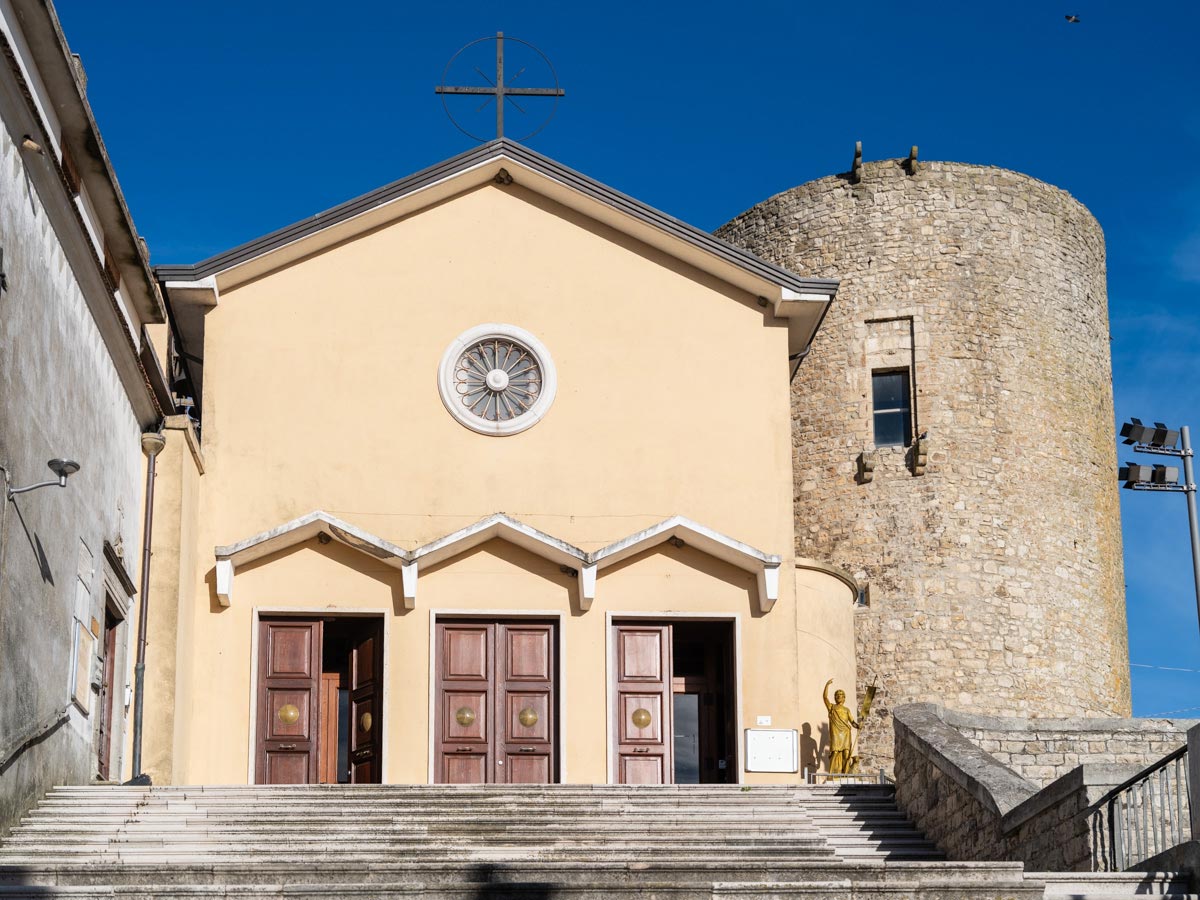
Church of Saint Roch in Castelluccio Valmaggiore: Stone, Memory, and Popular Devotion
Tempo di lettura:
In the heart of the Alta Valle del Celone, in Castelluccio Valmaggiore, one of the best-preserved medieval villages in the Province of Foggia and one of the least affected by…
In the heart of the Alta Valle del Celone, in Castelluccio Valmaggiore, one of the best-preserved medieval villages in the Province of Foggia and one of the least affected by mass tourism, stands a church that was not born from the ambition of a powerful patron or the will of a bishop. It was born out of fear. And then, slowly, it became a symbol of gratitude.
The Church of Saint Roch tells the story of a rural community in Southern Italy: its deep connection with the land, its livestock, and its destiny. It is a story worth reading carefully, because it echoes something far deeper than a simple account of architectural history.
The Origins: Protection Against Livestock Epidemics
When Faith also happened to be Veterinary Medicine
The origins of the church most likely date back to the eighteenth century, during a period when the community of Castelluccio was exposed to devastating livestock epidemics. Animal husbandry was at the heart of the local economy: sheep, pigs, and cattle represented not only a source of income but the very survival of farming families.
When anthrax (known in the local dialect as mbolla maligna, meaning “malignant fistula”) and livestock cholera struck, every loss was catastrophic. Faced with diseases that the medicine of the time could not contain, the community turned to faith. They chose Saint Roch, the pilgrim saint traditionally invoked against the plague and revered as the protector of the sick and of animals.
The church was almost certainly built as a collective ex-voto, an act of devotion by the entire community. The exact date of its construction is unknown, as direct historical sources are scarce, a common occurrence for rural churches in the inland architecture of Apulia, which were often born out of necessity rather than documented planning.
The 1787 Inscription: A Stone Plaque That Changed Everything
An Unexpected Discovery During the 1972 Restoration Works
In 1972, during renovation work, a local stone plaque was uncovered that would play a decisive role in the church’s recent history. The inscription, written in simple yet expressive Latin, commemorated the construction of a new altar dedicated to Saint Roch, built through the collective efforts of the local people in 1787.
The inscription reads:
“This altar, having been destroyed, was restored through the charity of the people and dedicated to Saint Roch, A.D. 1787.”
In just a few words, it tells an entire story. An altar that had already existed, had fallen into ruin, and was brought back into use through the generosity of the community. Not by ecclesiastical decree, nor by the generosity of a nobleman, but through the charity of the people. Today preserved in a private collection, this plaque became the symbolic inspiration for the reconstruction of the present-day church.
Demolition and Rebirth
From the Original Church to the Present Building
The original church, which had served generations of Castelluccio’s inhabitants, was demolished in 1952 after being declared unsafe. Before its demolition, the community saved what it considered most precious: the ancient wooden statue of Saint Roch, which was transferred to the Church of Santa Maria, where it is still preserved today.
The loss of the building did not mean any drop in devotion. Saint Roch remained the co-patron of Castelluccio Valmaggiore, and his feast day continued to be celebrated with the solemnity it deserved. It was the discovery of the eighteenth-century inscription that rekindled the community’s desire to give the saint a church of his own once again: the present-day Church of Saint Roch is the result of that uncovered memory.
Discover Castelluccio Valmaggiore and the Alta Valle del Celone
The Church of Saint Roch is one of the main landmarks to visit in Castelluccio Valmaggiore, but the village and the Alta Valle del Celone have much more to offer: historic churches, medieval streetscapes, deeply rooted culinary traditions, nature trails, and a calendar of events that brings the area to life throughout the year.
Explore other places, traditions, history, and flavors of Castelluccio Valmaggiore and the Alta Valle del Celone. Every corner of this land has a story to tell, you only need to stop and listen.
AT GLANCE
Where
Castelluccio Valmaggiore
Suitable for
All
SHARE


PODCAST
L’Alta Valle del Celone
Ten episodes exploring Celle di San Vito, Faeto and Castelluccio Valmaggiore through the voices of those who live in these places every day.
An audio journey through stories, memories, traditions, landscapes and flavours, told by the people of the three towns. The podcast guides visitors in discovering the authentic soul of the Alta Valle del Celone: a land of forests, villages and vibrant communities, where every voice preserves a piece of its identity.
Recommended experiences

The Highest Municipality in Puglia
The geography of the inland Foggia area holds remarkable …

Fresh Pasta Festival in Castelluccio Valmaggiore
Summer in the small villages of the Puglian (Apulian) Apennines …
Fresh Pasta in Celle di San Vito
There is an inseparable bond between the table of a small …
Keep exploring
The Highest Municipality in Puglia
The geography of the inland Foggia area holds remarkable …
Fresh Pasta Festival in Castelluccio Valmaggiore
Summer in the small villages of the Puglian (Apulian) Apennines …
Fresh Pasta in Celle di San Vito
There is an inseparable bond between the table of a small …

Ppìzze do le ccìcule: The Ciccioli Pizza of the Franco-Provençal Communities
There is a dough that carries the flavor of January. Of …