
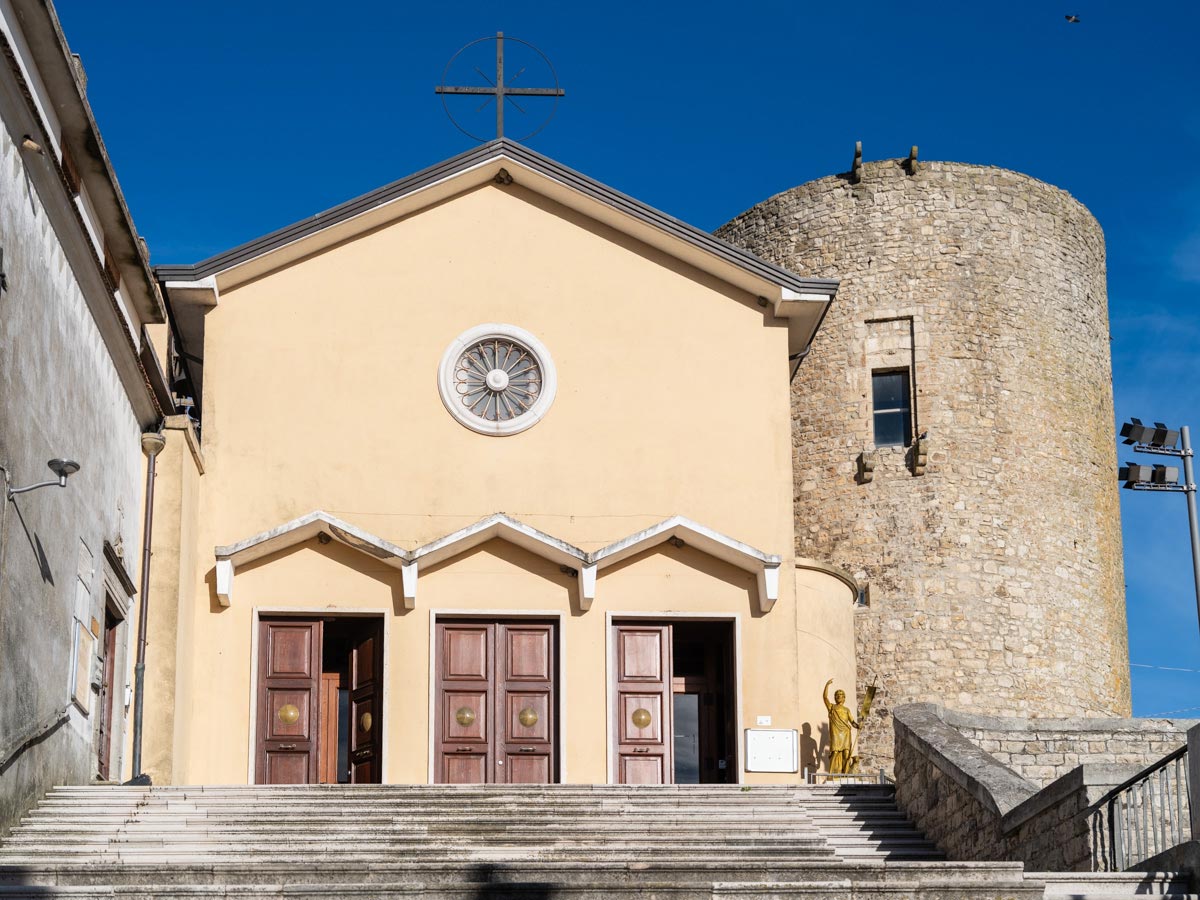
Byzantine Tower of Castelluccio Valmaggiore
Tempo di lettura:
At the highest point of the village, where the hillside becomes most exposed and vulnerable, stands the Byzantine Tower of Castelluccio Valmaggiore. Twenty metres of limestone have withstood the passage…
At the highest point of the village, where the hillside becomes most exposed and vulnerable, stands the Byzantine Tower of Castelluccio Valmaggiore. Twenty metres of limestone have withstood the passage of centuries, serving as silent witnesses to a layered past of military defence, territorial control and collective memory. It is the oldest surviving landmark of the village: a tangible reminder of those who, long before us, chose this exact spot in inland Puglia to look out over the surrounding land.
We are in the Alta Valle del Celone, in the Monti Dauni (Dauni Mountains), in that stretch of inland Puglia which slow tourism is rediscovering with increasing interest. Here, medieval villages are not stage sets but living communities with a history to be uncovered step by step.
A Tower at the Summit: The Shape of the Village and the Logic of Defence
Castelluccio Valmaggiore did not develop by chance. The village was laid out in the shape of an isosceles triangle, enclosed by defensive walls formed by fortress houses built directly against one another, where the outer walls of the homes also served as the village walls. At the base stood the two entrance gates: Porta del Pozzo and Porta del Piscero. At the apex of the triangle, the geometrically weakest, most exposed and most difficult point to defend, the Byzantine castle was built, with the tower serving as its defensive and observation core.
That tower still stands today.
Byzantine military architecture in Southern Italy rarely leaves such clearly legible traces in the landscape. The base of the tower is polygonal, consisting of 15 trapezoidal panels, each with a longer base measuring 2.40 metres, a shorter base of 2.27 metres and sloping sides of 2.15 metres. It is a precise geometric design, intended to distribute structural forces, withstand impact and provide a full 360-degree view over the valley below.
From its summit, the guards could monitor the stretch of the Via Traiana that crossed the valley floor: the Roman consular road linking Benevento to Brindisi, which for centuries served as one of Southern Italy’s main transport routes. Controlling that road meant controlling people, goods and information. The tower was not merely a refuge; it was a centre of surveillance.
From Castle to Church: Centuries Layered Upon the Same Site
On the site of the ancient castle, which was demolished or collapsed over the centuries, the Mother Church of Saint John the Baptist was built, reconstructed in its present form in 1958. It is one of the many examples found throughout Southern Italy where sacred architecture physically occupies the space once held by military power: the church stands where the fortress once rose, as though the community had chosen to protect the village’s highest point with a different kind of stronghold, spiritual rather than military.
The tower, however, endured. Today it houses a meta-museum dedicated to one of the most significant events of ancient Mediterranean history: the Battle of Cannae in 216 BC, where Hannibal’s forces inflicted one of the most devastating defeats ever suffered by the Roman army. According to the research and theory of Dr. Izzo, a physician and scholar from Castelluccio Valmaggiore, the battlefield was not located near the present-day recorded whereabouts of the Battle of Cannae but in actuality, in the vicinity of Castelluccio Valmaggiore. This theory places the area once again at the centre of a defining moment in Western history, and within the tower it comes to life through artefacts, documents and historical reconstructions.
Visiting the tower means, in a sense, passing through three layers of time: the Byzantine era of its construction, the medieval village that gradually grew around it, and the Roman-Punic period brought to life by the museum’s interpretation of the battle.
Castelluccio Valmaggiore: Gateway to an Authentic Itinerary Through the Monti Dauni
Those who come here to visit the tower rarely leave immediately afterwards. Castelluccio Valmaggiore is one of those authentic villages in the inland areas of Puglia (Apulia) where time seems to move at a different pace, and where every corner, a historic gateway, a rock church, a panoramic viewpoint overlooking the valley, reveals something that the more popular tourist destinations cannot offer.
The tower naturally forms part of a historical itinerary through the Alta Valle del Celone and the Monti Dauni: a journey that embraces medieval architecture, unspoilt rural landscapes, deeply rooted food and wine traditions, and a local culture that proudly resists homogenisation. It is slow tourism in the villages of inland Puglia at its most authentic: not a spectacle to observe, but a landscape to explore with curiosity.
Discover the other places to visit in Castelluccio Valmaggiore and the Alta Valle del Celone.
AT GLANCE
Where
Castelluccio Valmaggiore
Suitable for
All
SHARE


PODCAST
L’Alta Valle del Celone
Ten episodes exploring Celle di San Vito, Faeto and Castelluccio Valmaggiore through the voices of those who live in these places every day.
An audio journey through stories, memories, traditions, landscapes and flavours, told by the people of the three towns. The podcast guides visitors in discovering the authentic soul of the Alta Valle del Celone: a land of forests, villages and vibrant communities, where every voice preserves a piece of its identity.
Recommended experiences

The Highest Municipality in Puglia
The geography of the inland Foggia area holds remarkable …

Fresh Pasta Festival in Castelluccio Valmaggiore
Summer in the small villages of the Puglian (Apulian) Apennines …
Fresh Pasta in Celle di San Vito
There is an inseparable bond between the table of a small …
Keep exploring
The Highest Municipality in Puglia
The geography of the inland Foggia area holds remarkable …
Fresh Pasta Festival in Castelluccio Valmaggiore
Summer in the small villages of the Puglian (Apulian) Apennines …
Fresh Pasta in Celle di San Vito
There is an inseparable bond between the table of a small …

Ppìzze do le ccìcule: The Ciccioli Pizza of the Franco-Provençal Communities
There is a dough that carries the flavor of January. Of …